A complete replacement
Replace the regulator and motor together without transferring the old motor. A single assembly simplifies part selection and installation planning.

One part number. One matched assembly.
A window regulator and matched motor, supplied as one assembly. Four motor architectures are available: standard 2-pin DC, dual Hall sensor, sensorless ripple-count and LIN Bus smart motors. Each assembly is specified to the original vehicle's control system for an application-specific replacement.
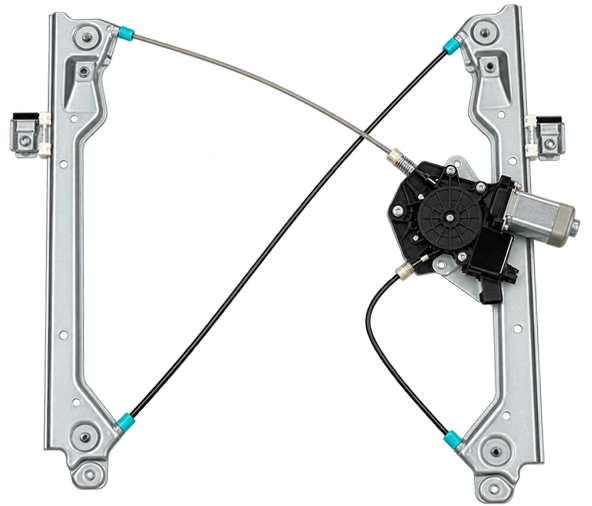
The right replacement is more than a matching mounting pattern. Motor direction, regulator travel, connector layout and control signals all matter.
Replace the regulator and motor together without transferring the old motor. A single assembly simplifies part selection and installation planning.
Mounting points, glass attachment, travel and connector orientation are specified to the original-equipment reference for each vehicle and door position.
Hall pulses, ripple-count signatures or LIN communication must match the vehicle’s door electronics—not just move the glass.
Each assembly follows the vehicle’s original motor architecture. These configurations are application-specific and are not interchangeable.
Smart motor and regulator combinations for network-controlled door systems.
Hall sensors provide pulse feedback used by the vehicle control system for window position and supported one-touch and anti-pinch functions.
Motor commutation produces a current ripple that the door module counts to track window travel—no separate sensor wiring.
Complete regulator assemblies for traditional power-window systems.
Voltage, feedback, one-touch operation and anti-pinch functions depend on the selected part number and vehicle system. A two-pin connector does not establish ripple-count compatibility. Learn more about each motor technology →
| Specification | Available configuration / confirmation required |
|---|---|
| Product format | Window regulator with matched motor, supplied as a complete assembly. |
| Operating voltage | 12V or 24V, according to vehicle application. |
| Motor architecture | LIN Bus 2.x smart motor, dual Hall sensor, ripple-count or standard 2-pin DC. |
| Feedback / control | Network commands and status (LIN), Hall pulse signals, commutation current ripple, or conventional DC drive. |
| Door position | Front / rear and left / right, defined per part number, including left-hand or right-hand drive where relevant. |
| Mechanical interface | Mounting points, glass attachment, travel and regulator geometry matched to the original. |
| Electrical interface | Vehicle-specific connector, pin count, polarity and signal requirements. |
| Smart functions | One-touch, anti-pinch and diagnostic feedback on applicable configurations. |
| Installation | Follow vehicle service instructions; initialization or relearn may be required. |
| Validation documents | Test scope and applicable quality documentation available on request for the selected part numbers. |
Han Yale combines regulator manufacturing with in-house engineering. Our verification approach considers the assembly, the door module and the vehicle as a connected system.
Review mounting geometry, glass attachment, connector clearance and full regulator stroke.
Check rotation direction and the feedback the original system expects: Hall pulse timing, ripple signature and gear ratio, or LIN protocol.
For smart assemblies, check one-touch operation, anti-pinch behavior and communication against the applicable door module or reference vehicle.
Confirm the part number, electrical specification and installation requirements before supply.
The window regulator mechanism and its matched motor are supplied together. Any included brackets, fasteners or additional components are defined per part number.
No. Standard DC and smart configurations support different control systems. One-touch and anti-pinch depend on the assembly specification and the vehicle’s electronics, and follow the original equipment configuration.
Matching pin count alone is insufficient. Both use two power wires, but a ripple-count application requires compatible commutation characteristics and gearing so the door module can track window position. Each reference is assigned the correct architecture during our cross-reference review.
No. These systems use different control architectures and should not be treated as interchangeable. Each reference on your list is assigned the correct configuration during our review.
Some vehicles require a window initialization or relearn procedure after replacement. Follow the vehicle manufacturer’s service procedure for the specific model.
Send us your part-number list or cross-reference file covering complete regulator-and-motor assemblies, regulators without motors and window lift motors. Our team will check coverage, confirm the configuration for each application and prepare a proposal covering available products and potential new developments.
A replacement assembly must match both the door mechanism and the original control system. We check fitment, motor rotation and travel on original vehicle doors, with signal validation for the applicable motor architecture. Voltage, functions and initialization requirements are defined per part number.