
Next-Generation Window Regulators & Smart Motor Technologies
An evidence-based engineering guide to the window regulator as a complete door system: the global migration from cross-arm to single- and double-guided cable regulators, the European door-electronics journey from integrated DCU to LIN Bus smart actuators and door-module ripple counting, and the motor interfaces — 6-wire dual Hall, LIN Bus and 2-wire sensorless ripple — that now decide whether a replacement part works.
Window regulator fundamentals: the complete three-layer system
Mounted inside the moisture-laden, thermally cycled cavity of the vehicle door, the power window regulator is a high-cycle mechatronic assembly. Tier-1 suppliers describe it as part of the door system — regulator, drive, position sensing, door electronics, switches and safety logic — and that is the right frame for anyone who buys, specifies or replaces one.
Rails, arms, cables, sliders, glass holders
Converts the drive into smooth linear glass travel. Cold-rolled galvanized steel lifter rails resist corrosion; reinforced POM sliders (glass carriers) take lateral wind and door-slam loads; glass holders or clamps keep the pane square in the run channel.
Han Yale design benchmark: slider pull-force above 150 kg on redesigned carriers.
Geared DC motor, self-locking worm, cable drum
A brushed permanent-magnet DC motor turning at roughly 60–90 rpm at the output through an irreversible worm-and-spur reduction. The worm gear self-locks, so the glass cannot be pushed down by hand or forced open from outside. 12 V passenger car, 24 V commercial vehicle.
Switches, door control module, BCM, LIN
Tracks glass position, executes express up/down (one-touch), estimates obstruction load for anti-trap reversal, performs end-stop normalisation, and reports thermal and over-current diagnostics on the vehicle network. The layer that changed most in fifteen years.
Three supply configurations in the global aftermarket
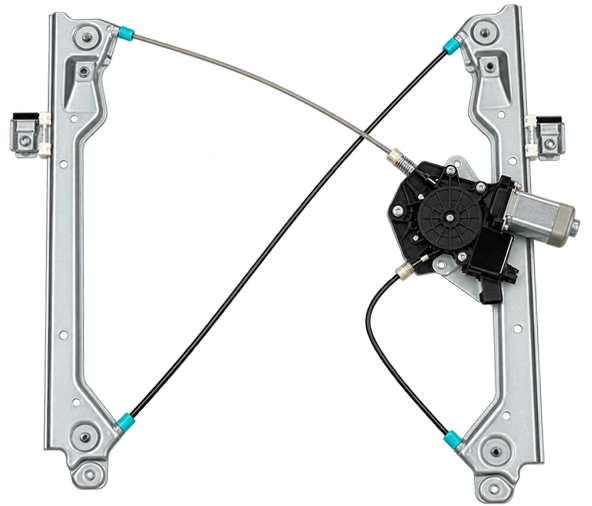
Regulator & motor assembly
(loads from hanyale.com)

Regulator without motor
(loads from hanyale.com)

Window lift motor
(loads from hanyale.com)
Mechanism families in the Han Yale range
| Family | Construction | Strength | Typical application |
|---|---|---|---|
| Cable (single guided) | One lifter rail, cable drum, two pulleys | Simplest, lightest, lowest cost | Front doors of compact cars, rear doors, Toyota applications |
| Double cable (double guided) | Two synchronised rails, four pulleys | Two-point glass support, quietest, no tilt | Full-size pickups, SUVs, frameless and wide glass |
| Door module carrier | Cable regulator pre-mounted on a steel, aluminium or thermoplastic carrier plate | Modular assembly; carries latch, speaker, harness | Ram 1500, Jeep Grand Cherokee, Ford Escape, VW and European platforms |
| Cross-arm / scissor (X-arm) | Two stamped arms on a centre pivot, sector gear | Robust, separate motor, tolerant of dust and vibration | Trucks, buses, older platforms, emerging markets |
| Single arm | One arm with sector gear and slide channel | Compact, simple | Toyota rear doors, small cars |
Why piecemeal component replacement causes premature failure. Generic repair guides suggest swapping a cracked pulley or re-tensioning a slack cable. But the door cavity sees thermal cycling, water ingress and abrasive grit. Micro-grooves on a worn rail permanently raise the friction coefficient, pushing motor current into chronic overload and confusing anti-trap thresholds; a frayed cable almost always scores the drum’s spiral track. A complete, precision-matched regulator assembly is the only way to restore OE-grade quietness, durability and correct obstruction-detection calibration.
Industry terminology: how OEMs and Tier-1 suppliers name the parts
| Term | Also called | Meaning |
|---|---|---|
| Window regulator | Window lifter (EU), Fensterheber (DE), power window regulator | The mechanism that carries and moves the glass |
| Single / double guided | Single rail / dual rail, cable type, Bowden-cable regulator | Number of lifter rails guiding the glass carrier |
| Cross-arm | X-arm, scissor, pantograph, sector-gear regulator | Crossed stamped arms with a toothed sector driven by the motor pinion |
| Door module / carrier plate | Door system, integrated door module, Türmodul | Carrier that integrates regulator, latch, speaker and harness; thermoplastic carriers appear on recent Ford platforms |
| Anti-trap protection | Anti-pinch, closing-force limitation, automatic reversal, bounce-back | Detection of an obstruction and reversal per FMVSS 118 S5 / ECE R21 |
| Express up / down | One-touch, auto up/down, comfort function | Full travel from a single switch tap; requires position tracking |
| Normalisation | Initialisation, relearn, basic setting, calibration | Teaching the controller the mechanical end stops after replacement or power loss |
| Short-drop | Window indexing, drop-glass | Frameless doors lower the glass a few millimetres on handle pull and re-seal after closing |
| DCM / TSG / DDM | Door control module, Türsteuergerät, driver door module | The electronics that drive the window motor and talk to the body controller |
| BCM / BDC | Body control module, body domain controller, Komfortsteuergerät | Central body controller; LIN master for door nodes |
Mechanism evolution: why Toyota and global OEMs shifted from cross-arm to cable systems
For decades, Japanese automakers — Toyota on Corolla, Camry and Hilux generations among them — and US truck makers favoured the cross-arm (X-arm) regulator for its heavy-duty ruggedness. On modern platforms, including Toyota’s TNGA generation and EV skateboards, single- and double-guided cable systems have overwhelmingly taken its place. Industry estimates put cable at roughly 62% of the global regulator market in 2025, and it is the fastest-growing construction.
Cross-arm (X-arm / pantograph)
Main and secondary stamped-steel arms cross at a centre pivot pin. The main arm carries a toothed sector gear driven by the motor pinion; rollers slide laterally in channels on the glass bracket.
Why it survived so long: high stiffness, exceptional tolerance of sand, dust and off-road vibration, and an almost always separately replaceable motor.
Four engineering drivers for its phasing out:
- Excess mass — typically 30–45% heavier than an equivalent cable unit, at odds with fuel-economy and EV range targets.
- Lateral space intrusion — the scissor arc sweeps through the door centre, blocking side-intrusion beams, airbag sensors and larger speaker enclosures.
- Non-linear stroke kinematics — mechanical advantage varies across the stroke, a poor fit for compound 3D curved glass.
- Pivot play and cocking — wear at the centre pin or rollers lets the glass cock sideways and wedge in the run channel.
Cable-drive systems (single & double guided)
Cold-rolled galvanized lifter rails, composite pulleys and multi-strand high-tensile wire rope pulled by a compact helical drum. A pre-tensioned spring in the cable loop absorbs end-of-travel shock and, on some designs, provides indirect anti-trap compliance.
Why Toyota and global OEMs adopted cable:
- Ultra-slim packaging — rails mount flush to the outer skin, liberating door depth for safety beams and acoustic liners.
- Lightweighting — typically 25–40% lighter than a cross-arm assembly for the same door; aluminium and thermoplastic carriers push further.
- Multi-point guidance — double-guided rails apply balanced lift at both edges of wide SUV glass (RAV4, Highlander class), eliminating cocking.
- Low NVH — smooth cable glide instead of gear-tooth chatter; what quiet EV cabins demand.
| Engineering dimension | Cross-arm (X-arm) | Double-guided cable | Single-guided cable |
|---|---|---|---|
| Door-cavity depth occupancy | Excessive — obstructs door centre | Minimal — flush to skin | Ultra-low — ideal for compact doors |
| Typical assembly weight | Heavy (~2.5–3.5 kg) | Light (~1.4–2.0 kg) | Ultra-light (~1.0–1.4 kg) |
| Compound-curvature glass | Flat or mild curvature only | Conforms to complex 3D glass | Medium curvature |
| Operating NVH | Moderate — gear-mesh noise | Quietest — smooth glide | Quiet |
| Field failure mode | Pivot and roller wear, glass tilt | Cable fray, pulley crack, drum scoring | Cable fray, slider wear |
| Motor serviceability | Usually separate motor | Often integrated; Series WR allows OE-motor reuse | Often integrated |
| Representative applications | Earlier Corolla / Hilux, Isuzu D-Max, trucks, buses | Toyota RAV4 / Camry, Ford F-150, Silverado, large SUVs | Compact hatchbacks, rear doors, frameless coupé doors |
Model-by-model regulator trend matrix: what the top-selling vehicles actually use
Han Yale tracks every generation of the highest-volume North American models by regulator construction, motor interface and lightweight material. The matrix below, maintained from the company’s own OE-door reverse-engineering programme, is what turns architecture theory into a stocking plan.
| Model (NA volume rank) | Front regulator trend | Current motor interface | Lightweight design | Han Yale reading |
|---|---|---|---|---|
| Ford F-150 (#1) | Double-guided cable | 2-pin ripple-count (2021+); 6-pin dual Hall (2015–20) | Aluminium | Signature-matched 2-pin motor required |
| Toyota RAV4 / Camry / Corolla (#2, #5, #8) | Cross-arm → cable on new generations | 7-pin smart motor with LIN transceiver (driver door); 2-pin on passenger side of older generations | Steel | OE smart motor retained via Series WR; LIN node under development |
| Chevrolet Silverado / Equinox (#3, #9) | Double-guided cable | 7-pin LIN front-left; 2-pin or 7-pin front-right by trim | Aluminium | Two motor variants per door position |
| Honda CR-V / Civic (#4, #7) | Cable (scissor interlude 2012–16) | 6-pin dual Hall, no LIN transceiver | Steel | Hall pulse count and pinout matched |
| Ram 1500 (#6) | Carrier plate + double cable | 6-pin dual Hall | Aluminium carrier (DT) | Module-on-carrier assembly |
| Ford Escape (#10) | Thermoplastic door-module carrier | 2-pin ripple-count (2020+); 6-pin Hall / 2-pin DC (2013–19) | Thermoplastic | Ripple signature; carrier-integrated design |
| Nissan Rogue | Cable | 6-pin dual Hall | Steel | Hall matched |
| Jeep Grand Cherokee | Carrier plate + double cable | 6-pin dual Hall | Steel | Module-on-carrier assembly |
Cable has won; the carrier is next
Every top-ten model now uses a cable regulator on the front doors. The next step is already visible: the regulator becomes part of a door-module carrier — steel on Ram and Jeep, aluminium on the DT Ram, thermoplastic on Ford Escape — that also carries latch, speaker and harness.
Steel → aluminium → thermoplastic
Full-size trucks moved to aluminium rails and carriers in the 2015–2019 generations; Ford’s Escape introduced injection-moulded carriers. Lightweighting is now a regulator specification, not only a body-in-white programme.
Three interfaces coexist — by door position
Honda, Nissan and Stellantis stay with 6-pin dual Hall; Toyota and GM use 7-pin smart motors with LIN transceivers on the driver door; Ford moved to 2-pin ripple. Many platforms mix interfaces between front-left and front-right, so the cross-reference must be per door, not per vehicle.
The European E/E trilogy: from integrated DCU to standalone MCU motors to LIN Bus smart actuators — and the ripple-count fork
European premium and volume automakers — Volkswagen Group, BMW, Mercedes-Benz, Renault and Stellantis — led the digitalisation of body electronics. Over 25 years, door control went through three phases, from heavy integration to functional decoupling to standardised in-vehicle networking. Today the market runs two architectures side by side: BMW’s latest generations drive the window with a LIN Bus smart actuator, while Volkswagen Group deploys both LIN smart motors and door-module ripple counting depending on platform, trim and door position.
The motor becomes the door control unit (DCU)
Representative models: VW Golf Mk4 / Passat B5 · BMW E46 3-Series · Mercedes-Benz W203 C-Class · Audi A4 B6
Architecture: the door-control PCB was integrated onto the motor gearbox housing. This monolithic unit governed window lift, mirror adjust/fold/heat, central locking actuators, puddle lamps and anti-theft sensing — 11- or 15-pin connectors on the motor-with-module unit. Position came from a Hall IC on the PCB; early VAG units already combined one Hall sensor with current shunts for anti-trap.
The aftermarket dilemma: door-slam shock and condensation degraded solder joints, and a minor switch or relay fault forced replacement of the entire expensive DCU-motor assembly.
Functional decoupling: standalone MCU motor with dedicated anti-trap
Representative models: Ford Focus Mk3 · VAG PQ35 / early MQB · Peugeot 308 · BMW E9x with FRM
Architecture: lock and mirror logic moved to centralised body or footwell modules; the window motor kept an independent microcontroller (or a Hall interface to the module) focused solely on pulse decoding, express up/down, end-stop normalisation and real-time anti-trap reversal.
Engineering benefit: smaller, more isolated electronics with far higher safety reliability and lower replacement cost.
Branch A — LIN Bus smart actuator: the motor as a network node
Representative models: BMW G-series (G20 / G21 3-Series, G30 / G60 5-Series, G05 X5, G07 X7, i4, iX) and Neue Klasse · Mercedes-Benz W206 / W214 · Volvo SPA / SPA2 · many Stellantis platforms
Architecture: the motor integrates an MCU, local H-bridge, dual Hall ICs and a LIN transceiver on the gearbox. Commands flow over three wires across the door hinge boot — +12 V (KL30), ground (KL31) and a single LIN line at 19.2 kbps — from the body domain controller (BDC / BCM) acting as LIN master. BMW’s latest regulators are LIN Bus: the smart actuator gives the millimetre-accurate frameless short-drop on coupés, Gran Coupés and convertibles, soft-stop speed ramping before the glass meets the upper seal, and bidirectional UDS diagnostics (temperature estimation, stall logging, position loss) back to the BDC.
Branch B — 2-wire sensorless ripple-count driven by the door module
Representative models: VW Golf VII / VIII, Passat B8, Tiguan, Atlas (rear doors 2024+), Skoda Octavia, Audi A3 / A4 variants · alongside LIN smart motors on other VAG applications
Architecture: the pendulum swings the other way. The door control module (Türsteuergerät J386 / J387) keeps all the logic and drives a conventional 2-pin DC motor through an H-bridge with a precision current shunt. Position, end stops and anti-trap are derived entirely from the commutation ripple on the motor’s own power wires — no Hall IC, no magnet ring, no transceiver in the wet door cavity. The door module still talks LIN or CAN to the body controller, so from the network’s point of view nothing changed; only the last metre of wiring did. Volkswagen Group runs both branches: ripple-count door modules on its highest-volume platforms, LIN smart motors where the application calls for them.
The service consequence: these platforms look like a basic 2-pin motor at the connector but behave like a sensing system in the module. A generic 2-pin motor fits, spins, and then loses express-up or trips false bounce-back because its ripple signature and gear ratio do not match what the module was calibrated for.
The anti-trap revolution: dual Hall, LIN Bus, and the Ford F-150’s sensorless two-wire ripple technology
Under US FMVSS 118 S5 (49 CFR § 571.118) and UN ECE R21, any power window with express auto-up or remote closing must incorporate an active anti-trap reversal: the window must reverse before the squeezing force on a test rod exceeds 100 N in the 4–200 mm opening, and upon reversal must open at least 125 mm or to the position from which closing began. Neither regulation prescribes a sensor or bus. Automakers meet it with three sensing paradigms on top of the conventional 2-pin motor.
6-wire dual Hall sensor motors
A multi-pole magnet ring on the armature shaft passes two Hall ICs placed 90° apart (quadrature) on an internal PCB.
Pin 3 Hall Vcc (+5 V regulated)
Pin 4 Hall ground
Pin 5 Hall channel A pulse
Pin 6 Hall channel B pulse
Principle: the door module counts quadrature pulses for exact travel and direction. When an obstruction slows the motor, the pulse period lengthens abruptly and the module reverses.
Applications: Honda CR-V / Civic, Nissan Rogue, Ram 1500, Jeep Grand Cherokee, Ford F-150 2015–2020.
Drawback: six terminals add harness bulk and oxidation risk in a wet door cavity. The pinout shown is representative; pulse count, logic level and pin order are application-specific.
LIN Bus smart actuator
MCU, H-bridge driver, dual Hall ICs and LIN transceiver are integrated inside the motor housing.
Pin 2 Chassis ground (KL31)
Pin 3 Single-wire LIN bus
Pin 4 (optional) Wake / ignition
Toyota / GM variants add switch inputs on a 7-pin connector
Principle: the BCM issues high-level motion commands; pulse counting, current tracking and safety reversal execute locally on the motor silicon within milliseconds.
Applications: BMW G-series and Neue Klasse, Mercedes, Volvo, Toyota RAV4 / Camry / Corolla driver door, GM Silverado / Equinox.
Advantage: clean three-wire harness with bidirectional diagnostics; function split defined in software.
2-wire sensorless ripple-count anti-trap
Deployed on: Ford F-150 2021+, Super Duty, Escape 2020+; Volkswagen Group door-module platforms; BYD and new EV architectures.
Zero Hall sensors, zero magnet ring, zero communication chips inside.
Physics: as brushes cross commutator segments, motor current dips and recovers — the commutation ripple. The door control module samples current through a precision shunt, band-pass filters it and counts ripples on the power wires themselves; ripples × mm-per-ripple gives position, and the load rise gives the obstruction.
Advantage: no electronics in the wet door cavity; maximum mechanical ruggedness; lowest harness cost.
Why generic aftermarket motors fail on Ford F-150 ripple systems: Han Yale’s waveform signature matching
Repair shops meet a stubborn mystery: a generic 2-pin replacement on a 2021+ F-150 spins, yet one-touch auto-up fails immediately, anti-trap faults and the window initialisation cannot complete.
The F-150 driver and passenger door modules (DDM / PDM) apply strict band-pass filtering to the current trace. Low-cost motors with poor commutator concentricity, mismatched brush composition or excessive arcing produce irregular ripple amplitude, double ripples and electrical noise. The module miscounts, assumes pulse desynchronisation and locks out automatic operation.
Han Yale benchmarks authentic OE commutation ripple with high-bandwidth oscilloscopes and matches commutator segment pitch, brush spring tension and dynamic armature impedance. Ripple amplitude and spacing are verified across temperature and supply-voltage extremes, then full-travel relearn, express-up and anti-trap reversal are confirmed on the genuine door module — the same real-vehicle method used for LIN nodes.
| Interface | LIN Bus smart actuator | Dual Hall sensor | Ripple count | Standard 2-pin DC |
|---|---|---|---|---|
| Position feedback | Hall sensing + on-board MCU | Two Hall ICs on a magnet ring | Current ripple from commutation | None (switch-controlled) |
| Where the logic sits | Inside the motor, commanded over LIN | Door module / BCM reads pulses | Door module counts ripples | Door switch / relay |
| Typical wiring | Power, ground + LIN (3–4 pin; 7-pin Toyota / GM) | Power + 4 sensor lines (6-wire) | 2-pin power only | 2-pin power only |
| What must match OE | LIN protocol, frame IDs, initialisation, diagnostics | Pulse count, timing, pinout | Ripple signature & gear ratio | Voltage, polarity, output |
| Typical applications | BMW G-series, Mercedes, Volvo; Toyota / GM driver door; VAG selected | Honda, Nissan, Stellantis; F-150 2015–20 | F-150 2021+, Escape, VAG door-module platforms, BYD | Entry trims, rear doors, CV, older fleet |
| Han Yale edge | Protocol decoded on the real vehicle | In-house Hall IC, application-specific tuning | Commutation tuned & real-door validated | OE-matched connector, rotation & output |
Field troubleshooting matrix and OEM window initialisation (relearn) protocols
Whenever the battery is disconnected, a door harness coupler unplugged or a new regulator installed, the door module loses its upper and lower limit calibration. Express functions are disabled and false anti-trap trips occur until normalisation is performed. Follow the symptom across all three layers before replacing parts — a scan tool can actuate the motor bi-directionally and show whether the switch press even reached the module.
| Symptom | Mechanical root cause | Electrical / control root cause | First check |
|---|---|---|---|
| Grinding or clicking during travel | Frayed cable, cracked pulley, drum grooves contaminated with debris | — | Remove trim, inspect cable path and drum |
| Glass tilts or drops into the door | POM slider fracture, glass-holder bolts backed out, broken guide | — | Check carrier and clamps; replace complete assembly |
| Rises to the header, then reverses 10–15 cm | Hardened run-channel seal raising load above threshold | Lost calibration — module mistakes the top seal for a trapped limb | Clean and lubricate channel; perform relearn |
| Switch pressed, relay clicks, motor silent | — | Worn brushes, glazed commutator, PTC thermal protection tripped after stall | Scope the motor supply under load; BMW specifies an inrush spike of about 19–20 A as a healthy signature |
| Motor runs, express and anti-trap do not | — | Wrong architecture: generic 2-pin on a ripple application, Hall pinout mismatch, LIN protocol / ID mismatch (DTC in BCM) | Confirm OE reference and motor interface before replacing again |
| Random reversal, auto-up drops out | Binding mechanism raising friction | Ripple miscount from noisy commutation or wrong gear ratio; software level needs update (Ford 26P02) | Compare motor ripple signature against OE; check module software |
| Both windows dead after cold snap (EU) | — | Door-module solder fatigue or LIN line fault; master door module controls the second door | Check LIN bus activity and module supply before replacing motors |
Representative OEM relearn procedures
Close the door → press the switch until the glass reaches full bottom travel and hold for 3 s → pull the switch up until the glass reaches the header and hold for 3 s → run one express cycle to verify zero normalisation. If bounce-back persists on 2025–2026 vehicles, check DDM / PDM software level per Ford 26P02 before further mechanical work.
Ignition ON → operate the window from the local door switch (not the master) → lower halfway → pull up until fully closed and keep holding UP for 2 s after closing → auto-up restores. On older generations with a separately replaceable motor, Toyota’s procedure initialises the motor on the harness before it is fitted to the regulator.
Ignition ON → pull the switch UP until the glass stalls against the upper frame → release and pull UP again for about 2 s → lower to bottom stall → release and hold DOWN for about 2 s. The door module stores the new motor’s ripple signature and baseline friction curve in J386 / J387 memory. Basic setting can also be run with ODIS or VCDS.
Close all doors → ignition ON → press and hold DOWN at the bottom stop for 5 s → immediately pull UP to the top seal and hold for 5 s → the BDC and smart actuator register the end positions and re-index the frameless short-drop. Initialisation can also be triggered from ISTA (Body → Locking and security → Power window initialisation).
What the technical evidence demonstrates: an objective engineering assessment
Claims about vehicle architecture must be substantiated by primary engineering evidence. Reviewed through October 2026: a reference design proves technical feasibility; a supplier page describes an offering; an OEM bulletin confirms its stated application. None automatically proves market share or a universal migration.
US market anti-trap & LIN architecture
Dual-channel Hall pulse counting and LIN-controlled anti-trap reference platforms are documented by NXP (RDS12VR, AN3147) and Microchip (APGRD002). FMVSS 118 S5 mandates reversal under 100 N but prescribes no bus or sensor type. Automakers deploy Hall, LIN or ripple-count by platform generation — and by door position within one vehicle.
Ford F-150 calibration & software serviceability
Ford’s 2025 F-150 owner’s manual documents window bounce-back; TSB 25-2448 (18 September 2025) targets one-touch calibration on 2021–2025 F-150; Customer Satisfaction Program 26P02 (10 February 2026) addresses false bounce-back on 2025–2026 F-150 and Super Duty with DDM / PDM software updates and relearn. Replacing mechanical parts without matching electrical and software parameters causes field failures. The 2-wire ripple interface itself is confirmed by Han Yale’s OE-door teardown of the 2021+ generation.
VAG: sensorless ripple counting confirmed — alongside LIN
Audi self-study programme 998703 (September 2007) for the 2008 A5 / S5 describes door modules estimating window position from motor-current harmonics, replacing Hall-based recognition and feeding pinch protection. Volkswagen bulletin 58-24-01 (20 March 2024) states that rear window motors on listed 2024 Atlas and Atlas Cross Sport changed from Hall sensing to sensorless position control. Tier-1 catalogues list Golf VIII front regulators with comfort function as 2-pin, where Golf IV / V units were 11 / 15-pin motor-with-DCU. Brose holds foundational ripple-evaluation patents (US 8,354,808; US 8,310,185). Other VAG applications use LIN smart motors; the interface is confirmed per chassis and door.
BMW G-series & Neue Klasse: LIN Bus smart actuator
Han Yale application data and OE motor references identify current BMW front-door regulators as LIN Bus smart actuators (3-pin KL30 / KL31 / LIN) driven by the Body Domain Controller, with dual Hall sensing inside the motor. BMW SIB 51 09 23 (revised 19 August 2024) covers carbon-brush and initialisation concerns on F44, G22 / G23 / G26, G42 and G82 / G83 and does not describe a sensing algorithm. A few G-series positions appear in aftermarket catalogues as 2-pin units — the 2-pin/LIN split is confirmed per chassis and door position, never assumed brand-wide. Brose has supplied BMW’s double-guided aluminium cable regulators with motor-integrated electronics since the E65 7-Series.
Cross-arm to cable: pronounced, not universal
Han Yale teardown records show RAV4, Camry and Corolla moving from cross-arm to cable regulators on their newest generations while retaining 7-pin smart motors with LIN transceivers on the driver door. Dorman records show cable designs on 1998–2002 Corolla and 2012–2017 Camry, so the change is application-specific coexistence rather than a brand-wide cutover date.
Sensorless current-ripple position estimation
Texas Instruments SLLA528 and reference design TIDA-01421, DRV8214 / DRV8234 integrated ripple counters, Microchip AN3049 and Renesas window-control references detail how door controllers sample commutator ripple over two power wires to count armature revolutions without Hall ICs. Bosch markets its FPG2 window lift drive in a 2-pin variant for systems with sensorless position detection, alongside Hall and integrated-electronics variants. AUMOVIO documents sensorless positioning in integrated door systems.
Where each region is heading — and how to specify the replacement
North America
A large, long-lived fleet with an average age above twelve years: strong demand for 2-pin DC and dual-Hall replacements on 2005–2020 platforms, while new programmes move to ripple-count (Ford) and LIN (GM, Toyota).
- F-150: 6-pin Hall → 2-pin ripple-count
- Express-up and anti-trap extended beyond the driver door
- Aluminium and thermoplastic carriers on trucks and SUVs
Europe
The most mature smart-motor market, running two architectures side by side: LIN Bus smart actuators (BMW, Mercedes, Volvo, Stellantis) and door-module ripple counting (Volkswagen Group, which also uses LIN on selected applications).
- BMW latest generations: LIN Bus smart actuator
- VAG: LIN smart motors and 2-pin ripple by platform / door
- Replacement must be protocol- or signature-correct — pin count proves nothing
Asia & ASEAN
The largest regional market by volume. Toyota pickups and MPVs are moving from cross-arm to cable, Japanese brands keep 6-pin Hall and 7-pin smart motors, and Chinese OEMs are adopting ripple-count.
- Toyota: cross-arm → cable on new generations
- Honda / Nissan: 6-pin dual Hall
- BYD and Chinese OEMs adopting ripple-count
Sourcing & acceptance verification checklist for importers and OEMs
Distributors and importers rarely source one part number; they build a programme across a vehicle segment. A correct replacement matches the original on four axes — mechanism, motor interface, electrical interface and initialisation behaviour.
| Review domain | Parameter to specify | Verification evidence required |
|---|---|---|
| Application traceability | OE reference, model year, trim, market, door position (LH / RH, front / rear — regulators are handed) | Validated cross-reference against the vehicle door shell; sample identification |
| Mechanical kinematics | Rail geometry, single / double guided, slider pull-force, glass-holder interface, mounting pattern, carrier type | Slider tensile report (Han Yale: >150 kg), door-fixture fit test, travel and interference results |
| Electrical interface | Operating voltage (12 V / 24 V), connector keying, pinout, rotation polarity | No-load / stall current report, terminal keying check |
| Feedback integrity | Hall pulse characteristics, or commutator ripple amplitude signature and gear ratio | Oscilloscope waveform benchmark against OE reference across temperature and voltage |
| Network communication | LIN frame IDs, baud rate (19.2 kbps), sleep / wake, checksum, diagnostics | Real-vehicle bus logging; zero DTC confirmation after initialisation |
| Safety compliance | FMVSS 118 S5 (≤100 N, ≥125 mm reversal), UN ECE R21 | Full-travel obstruction testing and false-reversal evaluation |
| Durability & environment | Life cycle, door slam, vibration, water, dust, thermal, burglary resistance, noise | HANSUN Lab reports to the 32 global standards listed in section 09 |
| Quality & supply | IATF 16949 status at design and production sites; sourcing footprint and tariff exposure | Certificates, PPAP level, capacity and lead-time commitment |
Han Yale Ind. Co., Ltd.: 37+ years of automotive manufacturing
Established in 1989, Han Yale (brand: HANSUN) supplies OEM, OES and aftermarket customers worldwide. Taiwan-based electronics, firmware and tooling engineering is paired with high-volume production at the Vietnam manufacturing hub for OE fitment, quality and supply-chain resilience.
Taiwan engineering & tooling centre
- In-house smart-motor IC design, electronic hardware and firmware development
- Real-vehicle LIN / CAN / ripple signal capture; every SKU validated on an imported OE door
- IATF 16949 certified quality system; major tooling, stamping, cable, slider and motor production in-house; Ca / Cp / Cpk data collected from every station
Vietnam high-volume manufacturing facility
- 20,000+ m² facility with capacity exceeding 100,000 units per month
- Robotic welding, plastic injection and automated cable lines
- IATF 16949 certification in progress, built on the Taiwan team’s quality standards; tariff-advantaged supply to the Americas, Europe and ASEAN
Fitment Guarantee programme: every SKU developed and test-fitted on the original car door
OE sample and door are a must
More than 3,000 OE doors imported to the Taiwan facility. Every single SKU has an OE sample regulator and its door, used for reverse engineering, validation and continuous improvement.
Module design, 3D-printed before tooling
Software simulation and modular design concepts shorten development and avoid extra tooling. Enhanced rib design, improved cable-reel housing, flexible cable tubing, high-tensile steel.
HANSUN Lab · 32 global standards
Vibration, anti-trap, component and cable durability, noise, environmental, fitment and function, burglary, waterproof, door slam and life-cycle tests on every new product.
90 days from design to production
Inquiry (day 1) → design (day 15) → validation (day 45) → trial run (day 60) → project launch (day 90). 70–100 new items developed each year.
Test-fitted once more before shipping
Every part is fitted on the actual door again before it leaves the plant; 100% real-time quality control on the line, very low return rate from existing sales.
100% with OE connector and housing
No wire splicing, no adapter harness. The motor arrives with the OE-matched connector, keyed and sealed, so installation time and installer risk both drop.
Three core product lines · one engineering platform
Window Regulator & Motor Assemblies
Complete direct-fit mechatronic units validated on real vehicle doors for stroke, speed and acoustics.
- 12 V / 24 V DC configurations
- LIN Bus, dual Hall & ripple-count variants
Window Regulators (Without Motor)
When the OE smart motor still works but cables or sliders have failed, the mechanism bolts straight onto the original motor.
- Galvanized steel rust-resistant rails
- High-tensile cable, 150 kg+ POM sliders
Window Lift Motors & Smart Control
LIN Bus 2.x smart actuators, dual Hall assemblies with in-house IC, 2-pin DC and sensorless 2-wire ripple-count motors.
- Real-vehicle validated protocols and signatures
- Low EMI, quiet operation
Before you source
What is the difference between a window regulator and a window lift motor?
The regulator is the kinematic mechanism — rails, cables, arms, sliders, glass holders — that carries and moves the glass. The lift motor is the drive unit: motor, worm reduction gearbox and optional control electronics. On some applications they form an inseparable unit; on others the motor is detachable. Han Yale supplies Series WR (mechanism only), WRM (complete assembly) and WLM (motor).
Is cable or cross-arm better?
They suit different doors. Cable is lighter, flatter and quieter and is the default on modern passenger cars; cross-arm is robust and easy to service and remains common on trucks, buses and older platforms. A replacement must match the OE design — and on cable types, single versus double guided.
Does every motor support express up and anti-trap?
No. These functions depend on the motor interface and the vehicle’s control system and are defined per part number and door position, not across the range.
Can a standard 2-pin DC motor replace a 2-wire ripple-count motor?
Matching the pin count is not enough. A ripple-count application relies on the door module filtering commutation current dips over the power wires. Generic motors with non-matching commutator segment pitch, poor concentricity or brush noise cause the module to miscount, disable express auto-up and trigger false anti-trap trips. Each reference is assigned the correct architecture during cross-reference review.
Can a 2-wire motor replace a 6-wire dual Hall motor, or a LIN motor?
No. The four extra wires on a 6-wire motor carry sensor supply, ground and quadrature pulses the module needs for direction and travel; a LIN motor must speak the vehicle’s application protocol, frame IDs and initialisation sequence. Without them, express and safety reversal are disabled and a DTC is stored.
Is window initialisation (relearn) mandatory after replacing a regulator?
Yes, for virtually all vehicles with express up or anti-trap. Whenever the battery is disconnected or the regulator replaced, the door controller loses its learned end stops. Following the OEM normalisation procedure restores current thresholds and safety operation — and a skipped initialisation is the most common cause of a “faulty” new part.
Why does Han Yale validate on real vehicle doors rather than test benches?
Bench testing cannot replicate seal compression, body flexion, supply-voltage drop or BCM network scheduling. Validating on actual OE door shells confirms mechanical fitment, acoustic behaviour, correct ripple or LIN behaviour and zero diagnostic trouble codes. That is why every SKU has an OE door in Taiwan.
Do you support references not yet in the range?
Yes. References are reviewed for development on a 90-day cycle; an OE sample of the regulator and the door are required to start, and OE motors can be sourced where a smart motor is retained.
References & regulatory documentation
Primary sources accessed through October 2026: statutory regulations, OEM technical service bulletins and training material, Tier-1 product literature and patents, semiconductor application notes, and verified aftermarket catalogue records.
- Electronic Code of Federal Regulations — 49 CFR § 571.118, FMVSS No. 118 Power-Operated Window, Partition and Roof Panel Systems (S5 automatic reversal: 100 N, 4–200 mm, reversal distance).
- UN ECE Regulation No. 21 — Interior fittings; power-operated windows.
- Ford Motor Company — 2025 F-150 Owner’s Manual (window bounce-back); TSB 25-2448 (18 September 2025); Customer Satisfaction Program 26P02 (10 February 2026); NHTSA recall 23V-507 (2023 Super Duty anti-trap software).
- Audi AG — Self-Study Programme 998703, 2008 Audi A5 / S5 (September 2007): door module window position estimation from motor-current harmonics.
- Volkswagen of America — Technical Bulletin 58-24-01 (20 March 2024): rear window motors changed from Hall sensing to sensorless position control, 2024 Atlas / Atlas Cross Sport.
- BMW AG — Service Information Bulletin SIB 51 09 23 (revised 19 August 2024): power window motor carbon brushes and initialisation, F44, G22 / G23 / G26, G42, G82 / G83.
- Brose Fahrzeugteile — US 8,354,808 B2, automatic detection of a mechanically commutated DC motor from its ripple pattern; US 8,310,185 B2, correction of counting errors in current-ripple evaluation (power window regulators); Brose double-guided aluminium cable regulators with integrated motor electronics for BMW 7-Series (E65).
- Bosch Mobility — Window lift drive FPG2: 2-pin variant for sensorless position detection; Hall and integrated-electronics variants.
- Texas Instruments — SLLA528 In-line current sensing in automotive applications; TIDA-01421 Automotive brushed-motor ripple counter reference design; DRV8214 / DRV8234 integrated ripple counting (SLVAFO8).
- NXP Semiconductors — RDS12VR anti-pinch window lift reference design; AN3147 window lift LIN slave. Microchip — APGRD002 window lift with anti-pinch; AN3049 sensorless position control by ripple counting. Renesas — vehicle window control with anti-pinch (ripple algorithm).
- Infineon — Door control module solutions; AUMOVIO — Power door control systems and software-defined smart door.
- Valeo aftermarket catalogue (Autodoc listings) — VW Golf VIII (CD1) front regulators with motor and comfort function: 2-pin; Golf IV / V motor-with-DCU units: 11 / 15-pin; BMW G20 front regulator with motor: 2-pin (selected positions).
- Dorman Products — 740-802 (Toyota Corolla 1998–2002, OE 69801-02040); 752-443 (Toyota Camry 2012–2017).
- Grand View Research / Data Bridge — Automotive window regulator market 2025 (cable ≈62% share, fastest-growing construction).
- Han Yale Ind. Co., Ltd. — Trend of Window Regulator (internal application study, Q1 2022, updated 2026): generation-by-generation OE-door teardown of top North American models; Window Lift Motors & Smart Control; LIN Bus Communication; Fitment Guarantee programme.
- Mikrocontroller.net — teardown of VW door control unit 6Y2959802 (T5 / Roomster): HC908 MCU, MC33689 LIN transceiver, Infineon TLE4945 Hall IC and stamped current shunts.
Vehicle examples illustrate architecture direction and should be confirmed per model year, market and door position. Diagrams are schematic, not vehicle-specific drawings.
Need window regulators or motors matched to a specific architecture?
Whether you need Ford F-150 ripple-count assemblies, European LIN Bus smart actuators, Toyota double-guided cable regulators or a door-module carrier, send your part-number list or cross-reference file. Our engineering team checks coverage, confirms the mechanism and motor interface for each door position and prepares a proposal with samples.
Submit part numbers for quote → Compare motor technologies →Meet us in person
Automechanika Shanghai 2026 · Hall 2.1 Booth B149
NECC Shanghai · Dec 2–5